The Day I Realized Lymphedema Was Running the Show
I’ll be honest with you.
I was standing alone in the bathroom, completely naked. Of course, I was — underwear adds weight. When you want to understand what your body is doing, every ounce suddenly matters.
Thanks for reading Notes From the Middle! Subscribe for free to receive new posts and support my work.
The number on the scale was five to seven pounds higher than usual.
Which didn’t make sense, because I hadn’t been eating any differently.
But the number wasn’t even the whole story. My shirts no longer fit around my arms. My belly looked like I was six months pregnant. And the exhaustion, the kind that doesn’t go away after a good night’s sleep, the kind that feels deeper than tired, had become impossible to ignore.
I stood there staring at my reflection and felt the thing I wasn’t supposed to feel.
Not gratitude. Not perspective.
Disappointment. Then frustration. And, if I’m being honest, a quiet anger I didn’t quite know how to handle.
Here’s what I finally admitted to myself that morning.
I had been treating lymphedema like a fifth-round draft pick.
Dutifully. Quietly. The way good girls manage things.
I wore the sleeves when I remembered. I did what I was told when I was told to do it. And when it flared up, when the heaviness returned, and the exhaustion settled in like weather, I waited it out and moved on.
I never really stopped to ask what it was costing me.
Because asking felt like complaining. And complaining felt like forgetting how lucky I was to still be here.
I survived cancer. That was the headline.
Everything else was supposed to be fine print.
But the fine print had been quietly rewriting my life for years, and I had been too busy being grateful to notice.
Here’s something they don’t put in the survivorship brochure.
When treatment ends, the compass disappears.
The oncologist, the infusion nurses, the care team that knew your name, your veins, and your worst days — they move on. Which makes sense. That’s how it works.
But you’re left standing there thinking, now what?
For me, the “now what” included lymphedema.
It had been there since treatment, quietly doing its thing. Seventeen years of survivorship, and not one doctor had ever asked about it.
What I heard instead, over and over, was this: lose weight. Exercise more.
So I did.
Because that’s what good girls do. We follow instructions. We don’t push back. We assume the doctor knows things we don’t, and we go home and try harder.
And then I’d exercise the way they told me to, and my body would spend the next month recovering from it.
Swollen. Exhausted. Frustrated.
And I’d feel ashamed. Like I had done something wrong. Like my body was being difficult on purpose.
What I didn’t know — because no one ever explained it to me — is that lymphedema doesn’t respond to generic exercise advice.
It has its own rules. Its own rhythms.
Pushing through it the way you’d push through ordinary fatigue doesn’t build strength.
It just costs you more than you can afford.
The fatigue is real. The pain is real. The heaviness that settles into your arms, your chest, and your whole body by the end of a long day is real.
These aren’t complaints.
They’re just the truth about what it means to live in this body.
And I’m tired of pretending otherwise.
The fact that so many of us carry this in silence, because no one ever told us we were allowed to talk about it, is something that needs to change.
So what do I know now that I didn’t know six weeks ago?
I know that lymphedema is not the minor character I cast it as.
I know that my body has been trying to tell me something for a long time, and I’m finally listening.
I’m moving differently now. Slower. More intentionally.
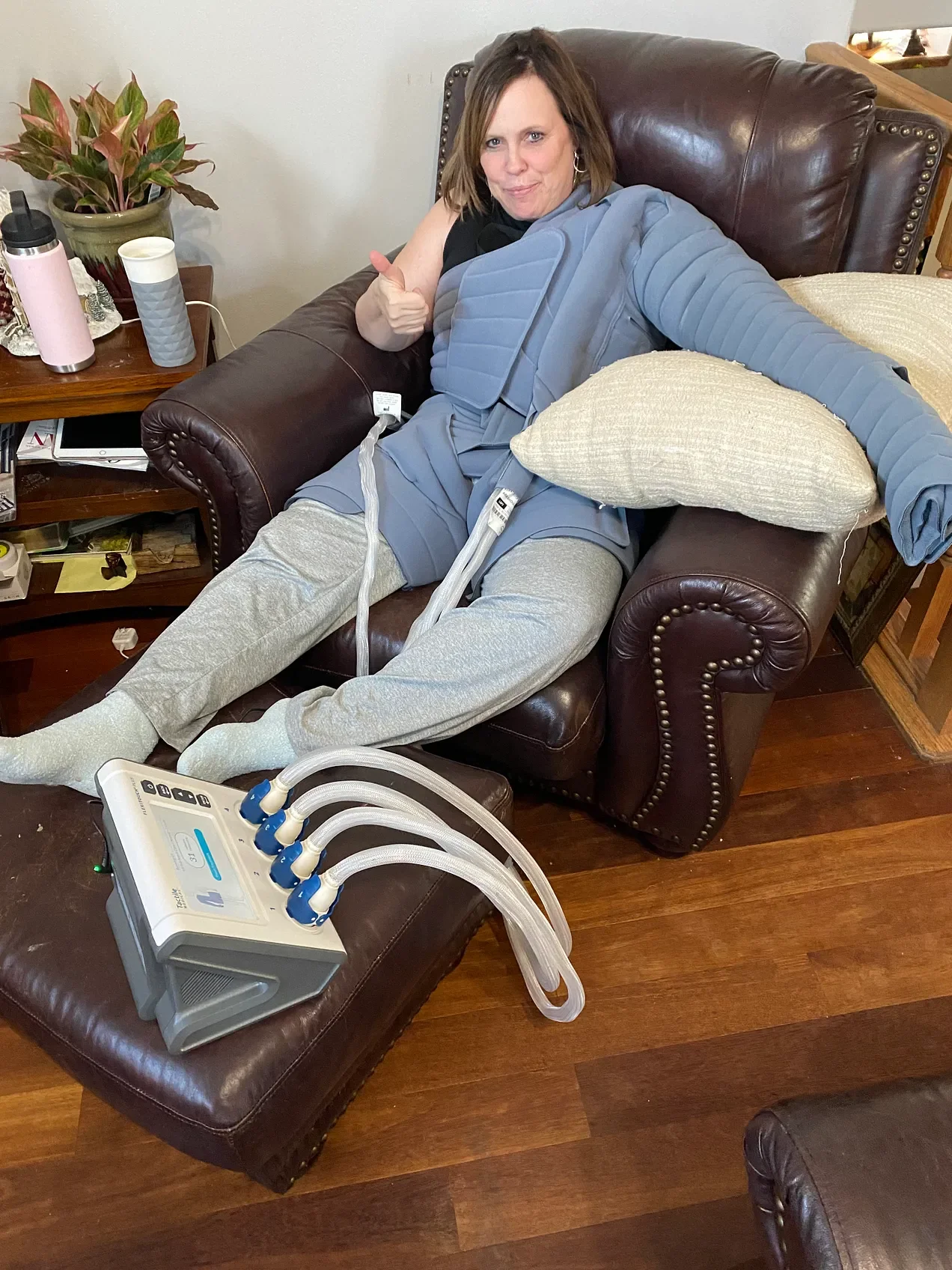
When I use the pump (twice a day for 60 minutes each time), I pair it with something I actually enjoy — reading, writing, or a quiet game of solitaire — so that taking care of my body starts to feel like something I do for myself, rather than something being done to me.
I’m asking questions.
I’m pushing back, gently, when the answer is just to lose weight.
I’m learning that advocating for my health is not the same as complaining, even when it feels that way.
It turns out good girls can do that, too.
And I’m holding this truth a little more gently now:
Lymphedema is here because treatment was here.
Treatment was here because I chose to fight.
The sleeve, the pump, the heaviness at the end of a long day — these are not signs that something has gone wrong.
They are evidence that I am still here.
That doesn’t make every day easy.
I won’t pretend it does.
But I have learned something about hope that I couldn’t have told you before cancer, before survivorship, or before six weeks of quiet reckoning in my own bathroom.
Hope doesn’t wait for things to get better before it shows up.
It’s already here.
It has always been here.
Right in the middle of the hard, the heavy, and the honest —
hope lives now.