Why Hope Lives Now — And Why It's Present Tense
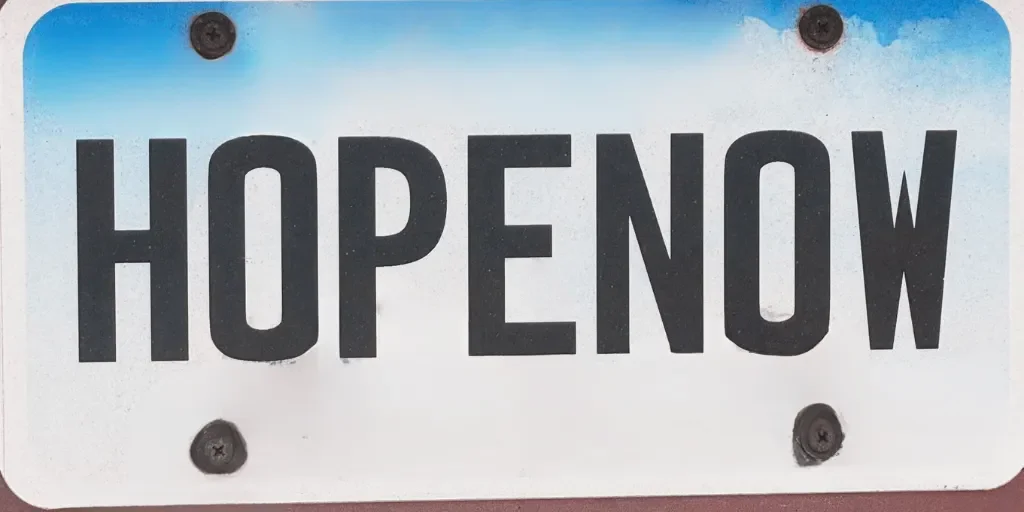
I have a set of license plates I’ve kept for seventeen years. My husband Ferlin had them made for me when I finished cancer treatment.
Two words:
HOPE NOW
I didn’t think much about the grammar of it at the time. I was just glad to be done. I was just glad to still be here.
But a few weeks after I got those plates, I was driving down a busy street in Sioux Falls when a car came rushing up beside me. The driver started honking. All four windows went down.
And four people started screaming at me. I won’t lie — I was terrified. And then I realized what they were screaming.
“Why hope NOW? Did you WIN THE LOTTERY?!”
I wish I could tell you I said something profound. Something worthy of a platform name. Something memorable and polished and deeply spiritual. But I was so startled that I just said: “I just finished cancer treatment.”
And they erupted. Hollering. Honking. Celebrating a stranger on a Tuesday afternoon.
I’ve thought about that moment a lot.
Why hope now?
Not hope eventually.
Not hope someday when the hard thing is over.
Not hope when the scans are clear.
Not hope when the body feels normal again.
Not hope when life finally settles down.Now.
In the middle. While you’re still in it.
That’s not just a license plate. That turns out to be the whole thing.
I started Hope Lives Now because I wanted to give other people what had been given to me, the sense that you are not alone in the middle of something hard.
That started with Hope Baskets and Blue Bags. Physical baskets and bags of things that said:
Someone sees you.
Someone is with you.
You are not forgotten.
I assembled them. I delivered them. I sat with women who were exactly where I had been. And I thought that was the work.
What I didn’t know then was that I was only in the early chapters of my own story.
Seventeen years later, I still live with lymphedema. I manage dysautonomia. There are days when I have to choose between running the pump or getting enough sleep, because time ran out and I can only do one.
There are days when the scale is up ten pounds from a weekend flare, not because I did anything wrong, but because this is what chronic illness does.
It doesn’t ask permission. It doesn’t check your calendar. On those days, I cry. I get frustrated. I have, on occasion, said words that would not look good on a faith platform.
And then I stop. And I remember.
He doesn’t leave. Not even during the temper tantrums.
That’s what hope in the present tense means. Not that every day is easy. Not that I have arrived somewhere peaceful and would like to tell you how to get here. Not that I always handle the hard things beautifully.
It means that in the middle of the hard thing — the ongoing, unresolved, chronic, exhausting hard thing — there is still something to hold onto.
And it holds you back.
I’ve wavered on a lot of things in seventeen years.
Treatments. Decisions. Plans. Platforms. What to call this work. Whether to do it at all.
But one thing I have never wavered on is this:
There is a God who is with me.
Even when I didn’t understand.
Even when I was angry.
Even when I was scared.
Even when the house was quiet at 3 a.m. and the fear climbed out of whatever box I’d put it in.
Hope doesn’t wait for the hard thing to be over.
That’s the whole point.
It lives now. It lives in the middle. It lives on the hard days and the good ones and the ones where you’re not sure what you feel yet.
That’s why I’m here.
This week, I launched a YouTube channel, something that’s been a long time coming and also feels slightly terrifying.
And I’m going to be showing up there the same way I show up here.
Real.
Honest.
Sometimes a little funny.
Always in the middle of something.
If you’re in a hard season right now, I want you to know:
You found the right place.
Pull up a chair.
New videos every week at youtube.com/@HopeLivesNow