What Survivorship Actually Costs
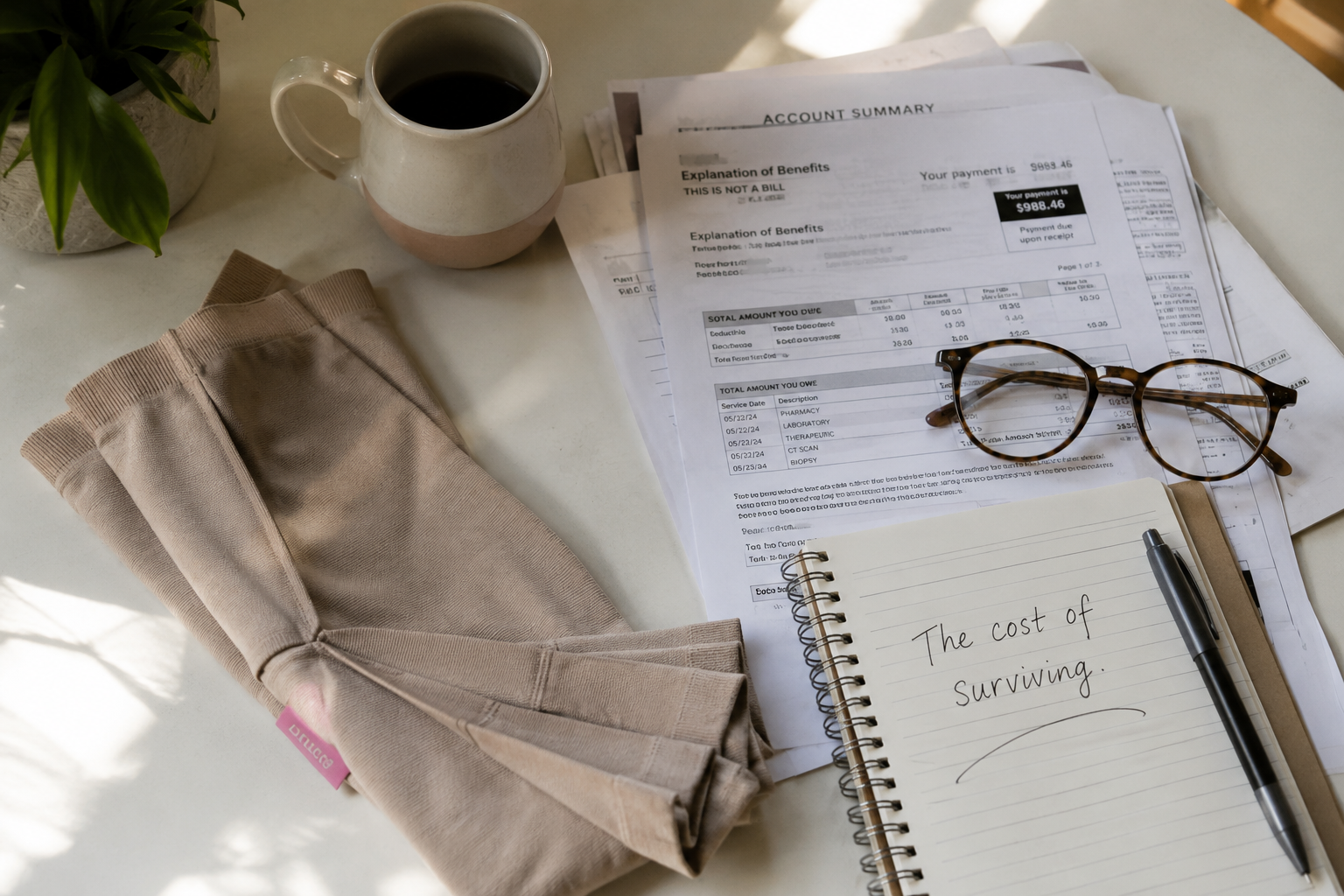
Treatment ends. Everyone claps. Someone rings a bell, or maybe you wish there had been a bell, and the calendar finally has empty squares on it again.
And then the bill comes.
Not one bill. A slow, ongoing bill. The kind nobody warns you about, because apparently nobody talks about this part.
So let's talk about this part.
The wig I paid for myself
When I lost my hair, I picked out a wig with my daughters.
We laughed. Took pictures. It was one of the good days in a very hard season. (I still have that picture, actually. We look like we're having entirely too much fun for what we were actually there for.)
What I didn't put in the caption: my insurance didn't cover one single dime of it.
A "cranial prosthesis" — which is the polite medical term for a wig you need because a drug is currently dissolving your hair follicles — is still coded as cosmetic on a lot of policies. So are a whole list of things cancer patients quietly need: scar creams, compression garments, specialized bras, lymphedema sleeves, dental work after treatment, physical therapy, counseling, gas money for appointments, time off work...you get the idea.
The sleeves I wear most days aren't a fashion choice. They're for lymphedema — a permanent souvenir from the lymph nodes they removed because my cancer had spread.
Nobody sends you a bill labeled "the cost of surviving."
They just quietly don't cover it, one line item at a time, and somehow you're supposed to absorb the difference while you're also absorbing chemo. Make it make sense.
This is not just my story
Here's what the research actually says, and I want us to sit with these numbers instead of skimming past them like we usually do.
Cancer creates financial hardship even for people with insurance. In the United States, the patient economic burden of cancer care was estimated at more than $21 billion in 2019 — that's out-of-pocket expenses plus the cost of patients' time spent traveling to, waiting for, and receiving care.
And that number doesn't even include the ripple effects. Lost income. Missed work. Reduced hours. Caregiving strain. What happens when your health makes it harder to keep the very job that gave you the insurance in the first place.
The burden isn't shared evenly, either.
One comparative study found that 55% of American cancer patients and survivors reported financial toxicity, compared to 34% in the United Kingdom, where the system carries the load differently.
Depending on the type and stage, a single year of breast cancer treatment — surgery, chemo, radiation, medication, follow-up — can run tens of thousands of dollars. Sometimes hundreds of thousands. Sometimes far more.
But here's the part that actually surprises people: the costs don't stop when treatment does.
Survivors keep carrying higher out-of-pocket medical costs than people without a cancer history. Surveillance scans don't stop. Follow-ups don't stop. Side effects definitely don't check the calendar. And the body you have after treatment is not always the body you had before it.
Survivors are also more likely to face work limitations because of their health, and that's not just about lost income. It can mean losing employer-sponsored insurance too — the very thing that was supposed to help pay for your care, gone right when you need it most.
And bankruptcy isn't some rare, distant thing that happens to people who "just didn't plan well." Research has shown cancer patients face increased bankruptcy risk after diagnosis, and financial insolvency is linked with worse health outcomes overall.
That should make all of us angry. I mean it. Genuinely angry.
Ten surgeries later
I'm not writing this one from the outside looking in.
I'm seventeen-plus years past my original diagnosis, and I've had ten surgeries since. Some cancer-related. Some complications cancer left behind on its way out the door. Sepsis was in there. Dysautonomia — something my body had apparently been quietly dealing with the whole time — was in there. Lymphedema is a daily, permanent line item that isn't going anywhere.
There was no year when I "finished" paying for cancer.
There were only years when the bills changed shape.
I worked through most of my treatment — not because I'm some kind of superhuman, but because I needed the paycheck, and I needed the insurance attached to it. I know how fortunate I was to have an employer who let me flex my schedule around chemo days. Not everyone gets that. A lot of people lose the job right when they can least afford to.
Why I'm not sanitizing this one
I could write you a softer version of this post.
I could tell you God provides — He does.
I could tell you we were carried by community — we absolutely were.
And I could leave it right there, tied up with a nice bow.
But I think the bow is part of the problem.
We tie a bow on survivorship so fast that the people walking through it right now — the ones staring down an EOB they can't decipher, or choosing between the co-pay and the electric bill this month — end up feeling like they're the only one failing at something everyone else seems to have figured out.
You are not failing. The system is genuinely, measurably not built with you in mind.
God has been my anchor through every single one of these years. That hasn't changed one bit. And I can trust Him completely while also telling you plainly what this actually cost.
I can trust God with the outcome...and still tell you the truth about the bill.
Ps. If you're currently staring at an EOB and trying to figure out what half those codes even mean — you're not bad at this. Nobody's good at this. It's not supposed to make sense.
Sources, for anyone who wants to sit with the numbers too: National Cancer Institute, "Annual Report to the Nation: Patient Economic Burden of Cancer Care" CDC, "Annual Out-of-Pocket Expenditures and Financial Hardship Among Cancer Survivors" JAMA Oncology / research on bankruptcy risk after cancer diagnosis Comparative study on financial toxicity among cancer patients and survivors in the U.S. and U.K.