Buy the Bubble Wand
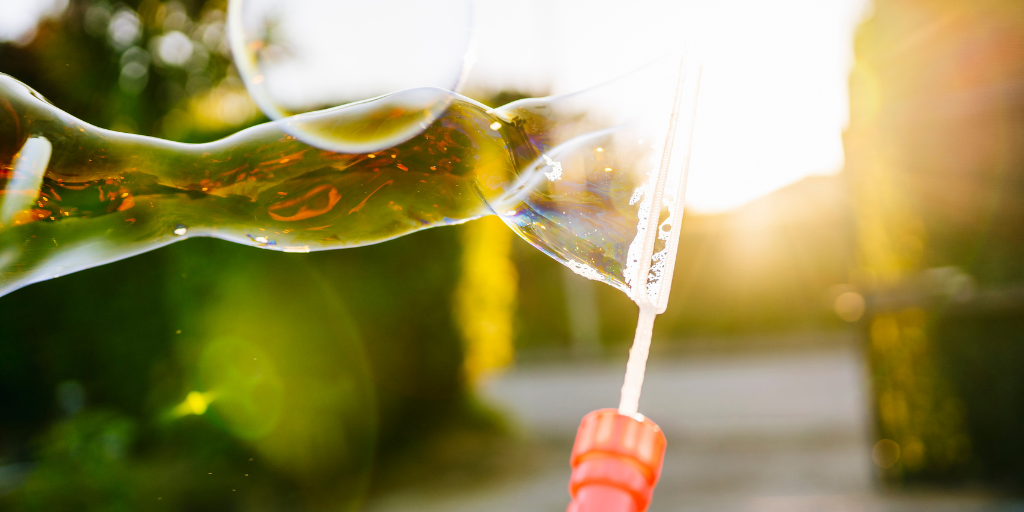
The bubble wand is nothing special. It’s plastic, a little cracked at the handle, the kind you might find in a dollar-store bin.
But last week, I stood in the yard and blew bubbles into the morning light anyway.
I watched them wobble above the flower bed, catch flashes of pink and gold, and disappear almost as quickly as they appeared.
For a few minutes, I wasn’t tracking my heart rate. I wasn’t scanning my body for the next dizzy spell or wondering what pushing too hard might cost me later. I was just watching sunlight bend across a soap bubble.
That’s it. That was the whole moment. And it took me a long time to let a moment be that small.
Maybe you don’t track your heart rate or calculate what today’s activity might cost you tomorrow.
Maybe your version is the grocery list running through your head while you sit on the porch. The laundry waiting downstairs. The email you should answer. The feeling that rest is only acceptable after everything is finished—which, of course, it never is.
Somewhere along the way, many of us learned to treat delight as optional and productivity as proof that we were doing life correctly.
We stopped playing unless it had a purpose.
We stopped making things unless they were good enough to share.
We stopped lingering because lingering looked too much like wasting time.
And we forgot how to let a moment be small.
The pushing-through lie
For years, pacing myself felt like letting dysautonomia win. I thought listening to my body meant allowing it to rule my life. So I pushed through. I kept moving, kept proving, kept trying to live as though my limits were merely a lack of determination.
But dysautonomia doesn’t care about supposed to. My nervous system runs its own math, and pushing through has never once balanced the equation. It only borrows energy from tomorrow.
What I didn’t understand for a long time was that the pushing wasn’t only about productivity.
It was also about safety.
As long as I kept moving, accomplishing, and proving I could still do things, I didn’t have to sit still with how uncertain my body had become.
But pushing through did not make me freer.
It often made my world smaller, because whatever energy I borrowed from the moment had to be repaid later.
I am beginning to understand that listening to my body is not the same as handing it control. It is paying attention. It is learning the difference between fear and wisdom, between giving up and choosing what will allow me to remain present for my own life. And strangely, as I have stopped fighting every limitation, I have begun noticing more of what is still available to me.
Flowers. Morning light. A cracked bubble wand.
Small joys I might once have rushed past because they did not accomplish anything.
What a bubble wand can do
There is something powerful about becoming completely absorbed in a small moment. Researchers who study awe and wonder have found that ordinary experiences of beauty can be connected to lower stress and greater well-being.
Wonder does not have to come from standing at the edge of the Grand Canyon.
Sometimes it is light through the trees. A bird landing close enough to watch. A flower opening. A bubble catching the sun.
For those of us who live with bodies that can feel unpredictable, these moments matter.
But they matter for the rest of us too. They interrupt the constant mental inventory of what has been done, what still needs to be done, and what we should be doing next. They remind us that life is not only found in finished tasks.
Not because bubbles cure anything. Not because joy can fix what hurts.
But because, for a few minutes, wonder invites us out of vigilance and into the present.
It reminds us that we are still here. And there is still beauty here too.
The joy that was never contingent
Scripture doesn’t treat joy as a reward for having everything together.
Nehemiah told a grieving and overwhelmed people that the joy of the Lord was their strength. Not their reward for becoming strong first. The source of their strength.
And Zephaniah gives us one of the most beautiful pictures of God in Scripture: a God who rejoices over His people with singing. Not a distant God merely tolerating us. A God who delights. If joy is part of who God is, then a little wonder in an ordinary afternoon isn’t frivolous.
It’s familiar. It’s a glimpse of Him.
Your version of the bubble wand
For me, whimsy looks like flowers and bubbles. Hands in the dirt. Light moving across soap film.
For a friend of mine, it’s paint squeezed straight from the tube with no plan for what it will become.
I know someone who collects sea glass simply because she loves the colors.
For you, it might be singing too loudly in the car.
Buying the ridiculous flowers.
Eating a popsicle on the front step.
Walking through the sprinkler with your grandchildren—or without them.
It might be using the good crayons, wearing the bright shoes, dancing in the kitchen, or reading a book that teaches you absolutely nothing.
None of it needs to be productive. None of it needs an audience. None of it needs to become content, a side hustle, or another thing to accomplish.
It only needs to pull you fully into the moment.
This weekend, with sparklers lighting up driveways and backyards, it seemed like the right time to say this out loud.
Light on a stick, drawn across the dark, gone in seconds. That’s whimsy too.
Maybe that is part of the point. It doesn’t have to last forever. It just has to be fully yours while it is happening.
So buy the bubble wand.
Light the sparkler.
Pick the flowers.
Use the good crayons.
Let the moment be small.
And let it be enough.
What is your version of the bubble wand?