The Sleeves
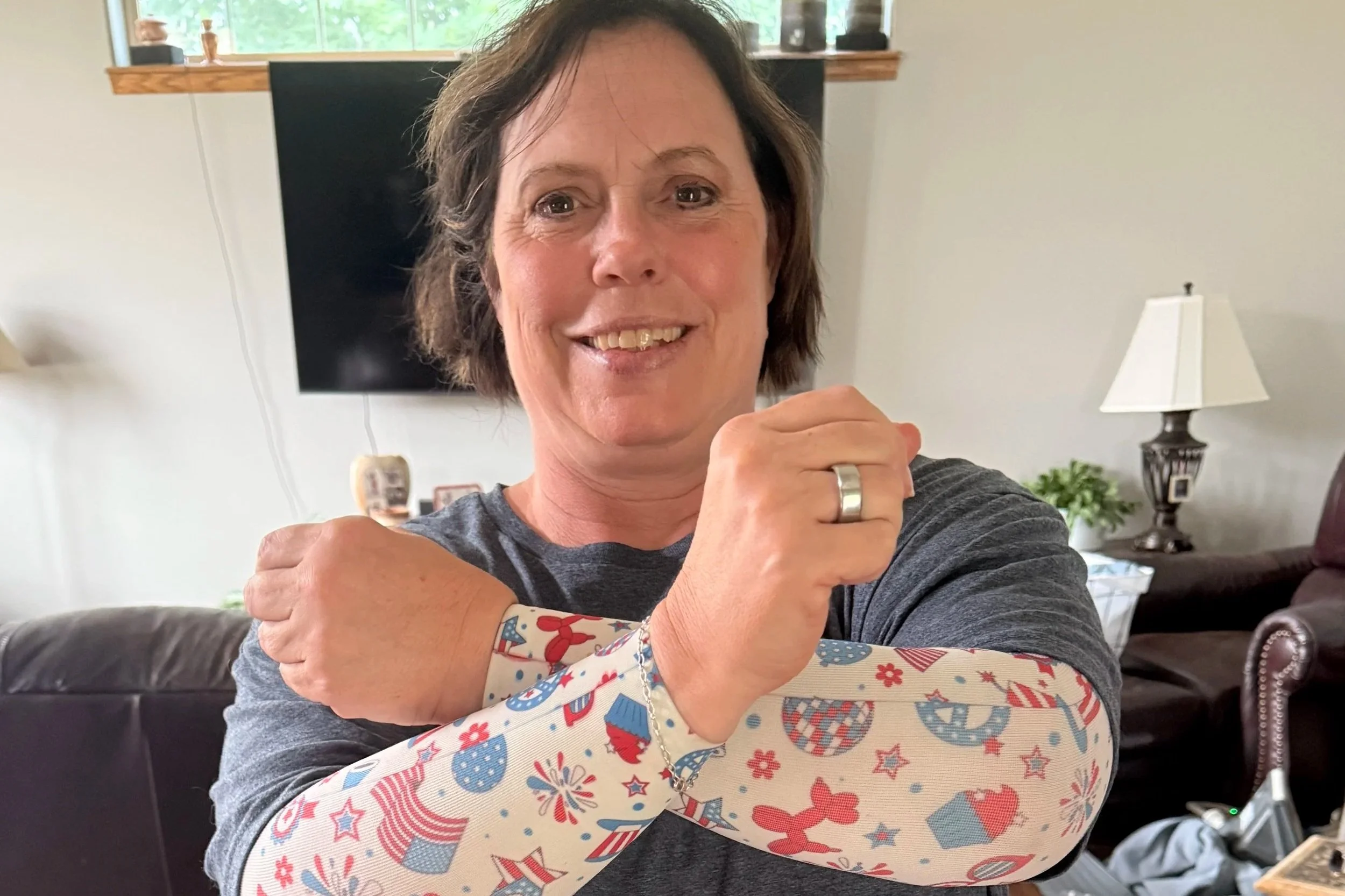
What I once hated most about surviving became an unexpected way of connecting with the people around me
Let me tell you about the thing on my arms.
They’re called compression sleeves.
And for a long time, they were the thing I hated most about surviving.
That’s a strong statement. Fifteen surgeries. Chemotherapy. Radiation. And somehow, lymphedema still wins the hatred category.
Make it make sense. And yet.
Lymphedema is a complication that can occur after cancer treatment, particularly when lymph nodes are removed or damaged. The lymphatic system can no longer drain fluid properly. Fluid builds up, and without ongoing management, the swelling can worsen.
It doesn’t simply go away.
There is no finish line where someone tells you that you have worn the sleeves long enough and can now return to your regularly scheduled arms.
There is only management.
Someone said to me just this week, “It gets better though, doesn’t it?”
No. Not in the way they meant.
It gets managed.
Those are two very different things.
I need you to understand that because the people in your life living with lymphedema need you to understand it too.
Management looks different for every person with lymphedema. It may include specialized therapy, movement, skin care, compression, pumps, or other tools recommended by their care team.
For me, a significant part of management means compression.
Every day.
I have bilateral lymphedema, which means both arms are affected and the sleeves come in pairs. Each sleeve runs between $75 and $125 and generally needs to be replaced every few months.
Do that math with me for a second.
And they’re beige.
Beige.
As if someone decided: You already have a chronic condition. Let’s make the thing you wear every day to manage it look like a bandage and feel like a bra three sizes too small. Or pants in a size 2 when you wear a size 14.
And Summer…in South Dakota…only makes it more challenging.
Heat. Humidity. Every single day.
But the discomfort is only part of why I hated them.
The sleeves draw attention to me.
At least, I am always afraid they do.
I have spent years feeling self-conscious in them, convinced that people are staring at my arms and wondering what is wrong with me. I don’t particularly enjoy being the center of attention under the best of circumstances. The sleeves make me feel visible in a way I never asked to be.
Last summer, I went to my niece’s baseball game wearing my sleeves, a T-shirt, and shorts. It was hot, and I already felt like a stuffed potato.
While I was standing in line, I noticed a woman staring at me.
The longer she looked, the more self-conscious I became.
She sees the sleeves, I thought. She’s wondering what happened to my arms. She probably thinks I look ridiculous.
Finally, she spoke. “My mom would love your T-shirt.”
My shirt said:
More coffee.
More books.
More Jesus.
She had not been staring at my sleeves at all.
She was reading my shirt.
I had spent the entire time shrinking under attention that wasn’t even there.
That is the strange thing about shame. It can make you feel watched even when no one is watching.
And sometimes, people are just trying to read your T-shirt.
A few years ago, I was at my daughter’s wedding in Mexico at the end of May. What was supposed to be one of the most beautiful weeks of my life became one of the hardest.
By the end of the week, I was miserable. I was dealing with what I now believe was heat exhaustion, although I didn’t recognize it at the time.
On the final day, Ferlin had paid good money for an excursion.
I couldn’t go. Instead, I lay on the bed wearing the bare minimum of clothing, with a fan blowing directly on me.
And I cried. Not only because of the heat.
Because of the shame.
The hardest part of lymphedema—harder than the cost, harder than the heat, harder than the beige—is the shame of feeling different and exposed.
It is the quiet voice that says you did something wrong to get this.
That it is your fault.
That you should have done something differently, and then maybe your lymphatic system would work like a normal person’s. Maybe you could wear a normal shirt on a beautiful day in Mexico at your daughter’s wedding without feeling like a stuffed plastic Michelin Man.
That voice is a liar.
But it is loud.
I have a physical therapist who helps me manage my lymphedema, and she is the best. She helps me navigate the living—the real, practical, daily reality of it.
And I have a counselor who helped me make peace with the sleeves themselves.
We actually did EMDR—a form of therapy used to help people process trauma and shift deeply held beliefs—specifically around the sleeves.
Specifically around the shame.
I want you to sit with that for a second. I needed trauma therapy to become okay with putting on my compression sleeves in the morning.
That is how deep the shame ran.
But here is what happened on the other side of that work.
I found the fun ones.
It turns out compression sleeves do not have to be beige. They come in patterns. Florals. Geometrics. And—my personal favorite discovery—designs that look exactly like tattoo sleeves.
Today I’m wearing patriotic ones in honor of the Fourth of July.
Red, white, and blue. Full grandma energy.
And people stop me.
“Cool tats.”
“Love your tats.”
“You’re a cool grandma with those tats.”
Depending on the day and the moment, I might use the opportunity to educate them. Sometimes I simply smile, say thank you, and let Grandma be cool for a minute.
But sometimes the conversation goes somewhere unexpected.
We visited Ferlin’s 88-year-old uncle in the hospital a few weeks back. He looked at my arms and asked whether I had gotten a tattoo. I told him no. They were compression sleeves. I take them off at night.
“Good,” he said. “I hate tattoos.” Then he paused. “Is that because of the cancer?”
Yes, I told him. A complication from the treatment. He nodded slowly and said, “Seems like we all have crosses to bear.”
Eighty-eight years old. Lying in a hospital bed. And he gave me one of the kindest things anyone has said to me in a long time.
Not, “I’m so sorry.” Not, “You’re so strong.”
Just: “Seems like we all have crosses to bear.”
I thought about that for the rest of the day.
And then there was the barista at the coffee shop who mentioned that she liked my sleeves.
The conversation that followed led to her telling me about her mom, who had died from breast cancer and had also lived with lymphedema. It was one of those tender, unexpected moments of connection that you cannot anticipate and cannot manufacture.
Something we do not do nearly enough anymore.
Just seeing each other.
Telling the truth.
Crossing the distance between strangers for thirty seconds.
My sleeves started it.
So now, most mornings when I put them on, I try to remember that they are hugs from God.
Tight ones.
Uncomfortable ones.
Hugs that compress and squeeze and remind me they are there approximately every four minutes.
And I’ll be honest with you. By the end of the day, when the swelling is at its worst and the sleeves are doing their hardest work, I have been known to look upward and say: “I know You love me, God. But this hug is squeezing all my kindness out. I’m getting crabby.”
He can handle it.
And tomorrow morning, I’ll put them on again.
If you or someone you love is navigating lymphedema, I see you.
It is not your fault.
There may not be a simple finish line, but with the right care and support, lymphedema can be managed.
And managed can be livable.
You are not alone in it.
—Kim