Good Girls Wear Compression Sleeves
What lymphedema is teaching me about perfection, chronic illness, and caring for the body I have
A few weeks ago, a restaurant owner stopped me and said, “Ma’am, I just love your tattoos.”
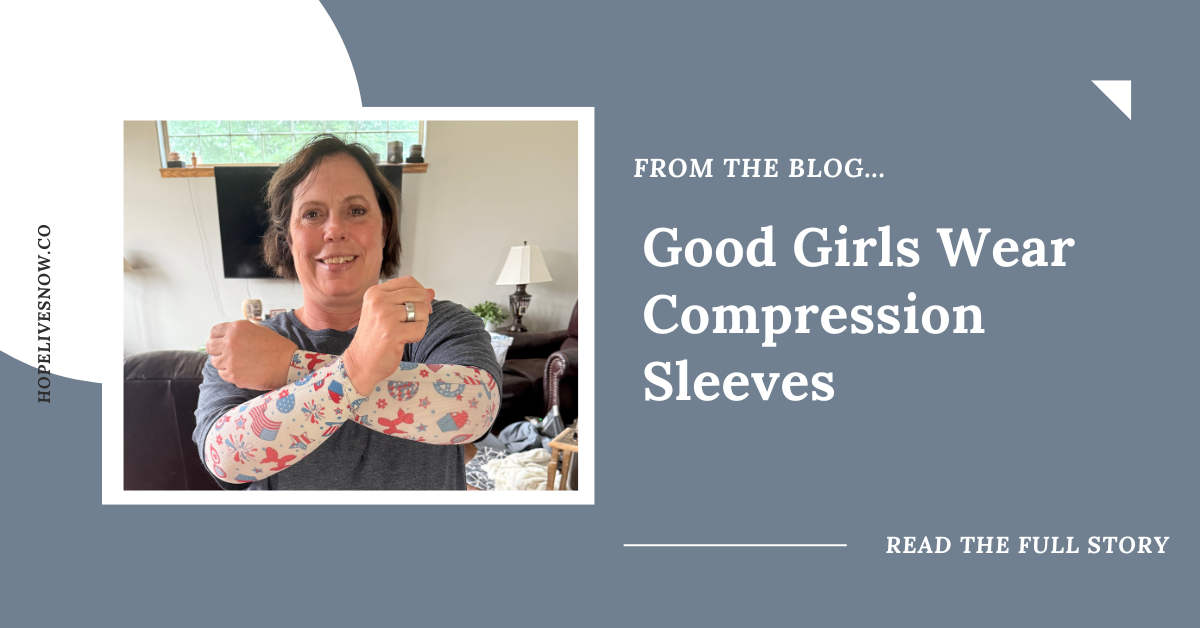
I had to smile. Apparently, after all these years of being a very good girl, I have finally acquired a wild side. Never mind that my “tattoos” are actually medical-grade compression sleeves covering two arms affected by lymphedema. I’ll take the compliment.
I’ve been a rule follower most of my life. I wanted A’s in school, I drive pretty close to the speed limit, and I like knowing what I’m supposed to do so I can do it correctly. Give me instructions, and I’ll generally do my best to follow them.
You’d think that would make me excellent at managing a chronic condition...but it turns out my body has very little interest in handing out good grades.
When cancer leaves something behind
I developed lymphedema a few years after completing breast cancer treatment. Mine is secondary lymphedema, which means it developed because of damage to my lymphatic system. During treatment, I had a bilateral mastectomy and lymph nodes removed from my left side, but by the time the swelling showed up, I was ready to put cancer behind me.
Then I took the dog for a walk and noticed something wasn’t right with my arm. Who knew walking the dog would introduce me to a condition I’d still be managing fifteen years later?
A physical therapist eventually taught me manual lymphatic drainage and helped me get a compression sleeve. At first, only my left arm was affected, but over the years, both arms became involved, and I now deal with swelling through my breast and trunk as well.
This is part of surviving breast cancer that I don’t think we talk about enough. We want treatment to have an ending, and I certainly wanted mine to have one. I was thankful to be alive and ready to get back to living, but being finished with cancer treatment didn’t mean my body was finished needing care.
Surely I could do this correctly
Once I understood what I needed to do, I approached lymphedema the way I’d approached most things: learn the rules and try to follow them. There were compression garments to wear and skin to protect, along with manual lymphatic drainage and eventually a pump to work into my days.
For several years, though, I bounced between being diligent and wanting to pretend the whole thing wasn’t happening. When I felt bad, I did what I’d been taught, and when I felt better, it became easier to convince myself I could let some of it slide. Eventually, my body would remind me that feeling better hadn’t meant the lymphedema had gone away.
The pump has probably been my biggest nemesis. It can be very helpful for me, but mine requires roughly an hour per arm, which adds up to two hours a day. Oh goody...because apparently I had two extra hours lying around wondering what to do with themselves.
There have been seasons when I’ve kept up with it and plenty when I haven’t. And because I’m me, missing treatment rarely stayed a practical problem. Instead of thinking about what had gotten in the way or how to make tomorrow easier, I turned it into a character assessment.
You know better, Kim. Why can’t you just do what you’re supposed to do?
Somewhere along the way, I’d decided that being responsible meant managing this without getting frustrated or falling behind. I wasn’t just trying to take care of my arms anymore; I was trying to prove I could do chronic illness correctly.
Then there was Mexico
A few years ago, we traveled to Mexico for our daughter’s wedding. I was still recovering from my DIEP reconstruction and the complications that followed, and I was determined to stay on top of my lymphedema while we were away.
I packed the pump, which requires its own suitcase, along with my compression sleeves and compression cami. I was going to be prepared, and I was going to do what I was supposed to do.
Then we arrived to temperatures over 90 degrees, awful humidity, and air conditioning that wasn’t working properly.
If you’ve never put on a compression cami, imagine trying to squeeze toothpaste back into the tube, except now the toothpaste is hot, sweaty, and increasingly irritated. Getting a sleeve onto a sweaty arm isn’t much better. (I’m pretty sure getting dressed should have counted as my workout for the day.)
I kept trying because I wanted to be responsible, but by the time the big day arrived, I felt so physically awful I couldn’t dance at her wedding. The following day, while everyone else was enjoying Mexico, I spent most of it lying on the bed in limited clothing (if you know what I mean).
I’d put so much effort into doing everything correctly...and I still felt miserable. I still don’t know exactly what went wrong, but I know it shook my belief that following the plan perfectly would guarantee I’d feel good.
I wish bodies worked that way. Mine certainly doesn’t.
The part underneath the sleeves
For me, lymphedema involves much more than an arm that looks swollen. During a flare, my arms can feel heavy and painful, and swelling through my trunk changes how my clothes fit. Sometimes I sleep poorly and feel incredibly fatigued, which makes it harder to do the very things that help me care for myself.
There’s also a part I haven’t talked about much: the shame I’ve carried about what it has done to my body.
There have been times when I’ve looked in the mirror and felt disgust, and that’s hard to admit. During a bad flare, I’ve described myself as a two-ton Michelin Man pull-up doll. (Lovely visual, I know.) But it gives you some idea of the way I’ve talked to myself.
For years, I wanted compression sleeves that attracted as little attention as possible. If I had to wear them, I wanted them to blend in, and I hoped nobody would notice what was underneath.
Recently, my brother mentioned that he hadn’t really seen other women wearing sleeves, so he didn’t think lymphedema could be very common. When I asked my physical therapist about that, she explained that many of the women she sees in clinic wear skin-tone garments or cover their compression with long sleeves.
That made me pause. I couldn’t speak for why anyone else chose those garments, but I knew why I had wanted mine to disappear.
Apparently this good girl gets tattoos
Getting there took more than an online shopping trip. I actually went to counseling before I could feel comfortable wearing sleeves that got noticed instead of hidden. (Who knew compression garments came with homework?)
Eventually, I decided to try sleeves with some personality. I bought patterns I liked, including some that look like tattoos, and discovered that I actually enjoyed wearing them.
An airport employee stopped me once to compliment my sleeves, and then came the restaurant owner who admired my “tattoos.” After spending so much time hoping nobody would notice my arms, I found myself smiling when someone did.
The sleeves haven’t made all my body image struggles disappear, but they’ve given me a different way to feel about something I wear every day. I can choose a pattern because I like it, and if someone asks about it, I have an opportunity to explain lymphedema.
I wonder sometimes whether another woman who’s had breast cancer might see my sleeves and feel a little less alone. I would have appreciated that myself.
And apparently, this very good girl is quite comfortable walking through an airport looking like she has two full sleeves of tattoos. Who knew?
Learning what helps my body
I’m also learning to pay closer attention to how my body responds, and swimming has been one of my biggest discoveries.
After foot surgery kept me out of the water for about five months, I finally returned to the pool and swam six laps. Then I went to the bathroom about six times in two hours. (I thought I was going to flood the place.)
But I also felt better, and I was reminded how much I’d missed being in the water.
Swimming has become a way to exercise that I enjoy and that seems to help with my swelling. It’s part of my care, alongside the treatment routine I’ve learned with my therapist, and I’m getting better at noticing when my body needs more attention.
That’s harder than checking boxes...at least for this rule follower. It means being honest about how I feel, including when I’m tired or frustrated, and figuring out how to fit care into the life I’m actually living.
Yesterday was yesterday
I wish I’d taken my lymphedema more seriously fifteen years ago. I wish I’d understood sooner that it deserved attention even when I didn’t feel like dealing with it.
But I also wish I hadn’t spent so much time using it as another reason to be disappointed in myself.
There are days when I’m tired of the pump, and putting on a compression garment feels like one more thing I don’t want to do. I can understand why I’ve sometimes wanted to ignore the whole business, even though I know it still needs care.
I’m trying to meet those days with a little more honesty and a lot less scolding. Instead of reviewing everything I should have done yesterday, I’m learning to ask, “What can I do today to care for my body?”
The answer depends on the day. Sometimes I need to make time for the pump, and sometimes I need to recognize how exhausted I am and give myself room to rest. I’m still responsible for my care, but being disappointed in myself hasn’t made that care any easier.
The body God still loves
For a long time, I thought about lymphedema almost like Paul’s thorn in the flesh. Paul asked God three times to take his away, and God answered, “My grace is sufficient for you, for my power is made perfect in weakness” (2 Corinthians 12:9). I always read that as hang in there, Kim. This was something permanent I would have to live with, and I trusted God to help me endure it.
I still believe He sustains me...but lately I’ve been wondering if grace covers more than enduring. Maybe it also covers how I talk to the body He loves...swollen arms and all.
These days, when I pull my sleeves on, I try to think of them as a hug from God. I do love His hugs. But some days, I’d really prefer a different reminder of His love...preferably one that doesn’t require a wrestling match to get on.
Even so, I can look at my bloated abdomen in the mirror and struggle to offer myself any kindness at all. I can thank Him for the gift of being alive and still feel deeply uncomfortable in the body that survived.
I don’t have that all worked out. I still don’t like lymphedema, and I’d happily give up the pump and all the planning that goes with it. Being thankful for my life hasn’t made those parts easy.
But I’m beginning to wonder how caring for myself might change if I stopped treating my body like it was constantly letting me down. It has been through a lot, and it needs help. I can give it that care without every hard day turning into a report card.
I’m still a rule follower, and I still like getting things right. (I even drive pretty close to the speed limit...most of the time.) But I’m learning that caring for this body is something I’ll keep working at, with God meeting me in the frustration along the way.
Yesterday was yesterday. Today I can begin again.
And if that means heading out the door covered in fake tattoos, well...turns out good girls can do that, too.
If you’re living with lymphedema too, or love someone who is, I’ve gathered some resources that have helped me on the Hope Lives Now website. Lymphedema Resources. You don’t have to figure this out by yourself...and you definitely don’t have to do it in beige sleeves.
Ps. If you see a woman in an airport with two full sleeves of tattoos, feel free to say hi. Fair warning: I’ll probably tell you more about the lymphatic system than you ever wanted to know.
Pss. Faces of Cancer is out this month! It’s full of real stories about life during and after cancer...including the parts nobody warns you about. Check it out here!